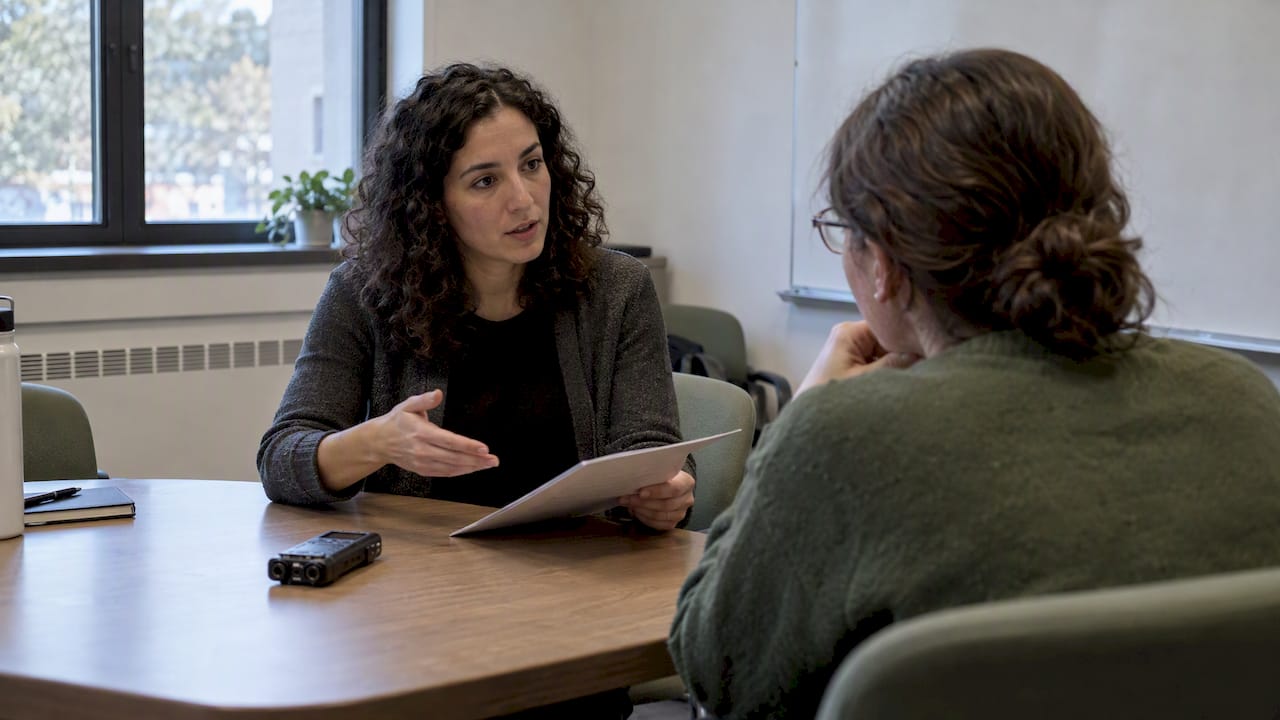
For doctoral interviews, a useful transcription workflow protects participants and preserves an accurate research record. Choose the process with your supervisor and institution before recording. A convenient local app does not by itself determine whether a project needs ethics review, what participants agreed to, or which services your institution permits.
Start with the approved research plan
Ask the relevant ethics or institutional review office how the project is classified and which approvals, consent materials, and data controls apply. Requirements depend on the project, institution, funding, jurisdiction, and information collected. Do not assume that every thesis is exempt or that every recorded conversation is governed by the same rules.
OHRP describes informed consent as an ongoing communication process, not merely a signed form. Its FAQ is older guidance and points readers to the applicable current regulations. Use your institution’s current approved materials for the actual study rather than copying an online checklist into a consent form.
Describe the real recording workflow
Be clear about whether you will record audio, transcribe it, use an external service, generate summaries, and publish quotations. Establish who can access identifiable recordings, how long they will be retained, how they will be protected, and what withdrawal can mean once analysis or publication has occurred. Use the wording and limits approved for your study.
Map the path from microphone to audio file, transcription, correction, coding, backup, and final archive. Include transfers to collaborators and any AI tools. Replacing a name with a participant code does not necessarily remove identifying details from a voice recording or a distinctive life story. Keep the identity key separate where your approved plan requires it.
Run a pilot before the first interview
- Use a fictional conversation to check sound quality and microphone placement.
- Verify that required models and storage are ready before relying on offline capture.
- Test importing the supported audio format, reopening the recording, and exporting a usable transcript.
- Confirm where exported files and backups actually go.
- Check whether a second authorized researcher can use the output without receiving unnecessary identifying material.
- Record the tool version, configuration, and known limitations in your project notes.
Apple’s speech privacy notice illustrates why the exact feature matters: system dictation and Siri are not interchangeable with every third-party transcription route. Verify the specific application and workflow named in the study plan.
Make verification part of analysis
Keep the source recording and a versioned transcript according to the retention plan. Distinguish speaker labels, verbatim words, uncertain passages, editorial corrections, and analytic comments. Check names, numbers, specialist vocabulary, negation, overlaps, and any extract you intend to quote. An automatic summary should not silently become a participant’s statement.
For example, retain an uncertainty marker and timestamp when a phrase cannot be heard clearly. Do not fill the gap with a plausible sentence. Before coding an important theme, return to the relevant audio and its surrounding context. Keep generated interpretations separate from your coding decisions and describe material tool use honestly in the methods account.
Finish with a controlled archive
Follow the approved plan for access, retention, deletion, and sharing after the thesis. A personal cloud folder is not automatically an institutional research archive, and deleting the app does not establish deletion of exports or collaborator copies. If you need to change the data-handling process, consult the responsible institutional team before making the change with participant records.